Sunday, December 6, 2015

How to Design a Coffee Bar for a Kitchen By Carrie Waller

With counter space so often at a premium in today's kitchen design, it can be frustrating to have to make room for appliances — even essential coffee makers. Instead of stowing your maker in the cabinet each day or sacrificing countertop square footage to have it out in the open, create a special place in your kitchen to corral all of the accoutrements in style. Putting together an at-home coffee bar on a moveable cart or bookshelf near an outlet makes it easy for you to brew and grab a cup of Joe (or tea), and all it takes is a simple DIY system for displaying mugs, plus a couple of designated shelves for housing the necessary accessories that go with it. Here's how to get the look on your own.

An at-home coffee bar makes it easy to grab a cup of at-home Joe or tea.

Display Mugs with Hanging Rods First, establish a system for displaying mugs by using an inexpensive bar and hook system, which will allow for coffee mugs to stay out in the open all week long for brew-and-go cups of coffee. Hold the bar hardware up to the wall at eye level, and check that everything is level. Mark right on the wall by putting your pencil tip through the holes in the hardware, and draw circles to match the opening. Next, use a power drill to drill holes in the wall. Drill into at least one stud if you are in an area that experiences seismic events. Use toggle bolts if you're drilling just into drywall. Finish by screwing the hardware that came with the bar system through the supports and into the wall. Attach the rod to the supports using the accompanying bolts, loop the metal hooks onto the rod and then hang mugs onto the hooks.

Turn your mugs into decor for the kitchen.


Set Up Open Shelves for Easy Organization Attach two 24-inch-long pieces of pre-cut, pre-painted hobby wood one-by-fours together using screws and two L-brackets. Before putting the L-brackets in place on the wall, mark and drill your holes on the back and underside of the pieces of wood. Then, measure 12 inches down from the mug rod display on the wall and mark two level holes, about 12 inches away from one another. Drill the two holes, first in the drywall and then in the top half of the L-shaped shelf. Then attach the shelf to the wall with heavy-duty drywall screws. Finish by adding coffee pods to the shelf to keep them within easy reach.

Keep single-serving coffee cups or pods at the ready.

Add a Touch of Inspiration Add a whimsical, motivational saying on the wall, right above the mug rod display, by hand-writing the letters with a permanent marker or by ordering and adhering vinyl decal letters. If you use a marker, allow the letters to dry for at least 30 minutes before touching them. 

Use a marker or decals to add a motivational quote above your coffee bar.

Keep the Space Cohesive with Color Style the coffee bar bookshelf below with all of the necessary accessories — things like a coffee maker, extra coffee grounds or beans, specialty mugs, tea bags, sugar dishes and coffee stirrers or spoons. By keeping the accessories in a unified color palette, you'll create a cohesive and intentional look that doesn't compete with the rest of the space.
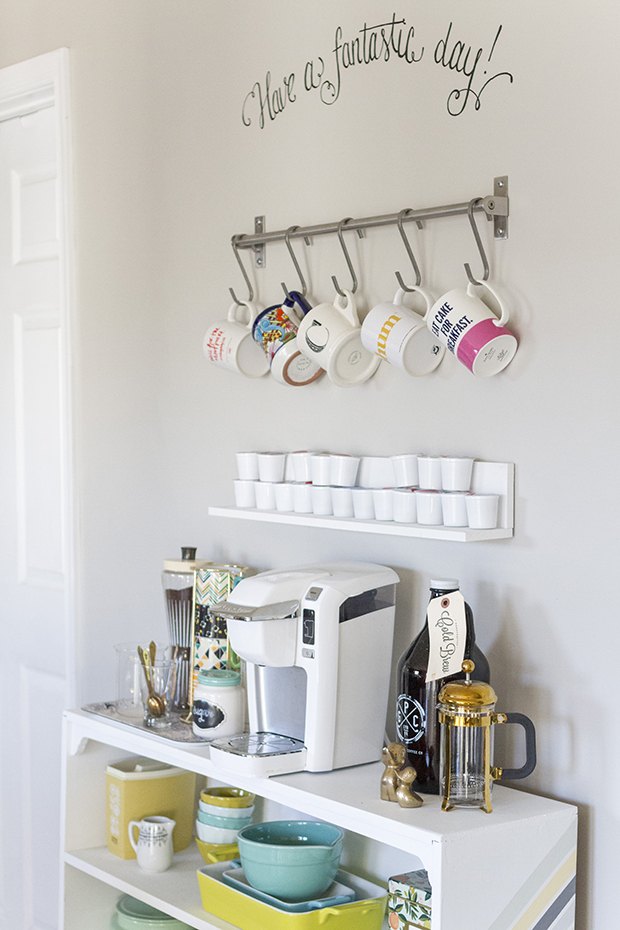
Matching the color palette of your space will keep it from looking cluttered.

Tips & Warning
Read also:How to Start Your Own Home Decor Lin

Saturday, December 5, 2015

How to Start Your Own Home Decor Line By Trudie Longren

home design, home decor, How to Start Your Own Home Decor Line
People with fashion design talent may launch their own home decor lines, recognizing the demand for unique touches to living spaces. Starting a home decor business can be a profitable and enjoyable way to put artistic design talents to work. With your home decor line, you can help people give a new lease on life to a tired sofa with a fashionable new slipcover or add a splash of color to a dull wall with trendy curtains. Home decor products can transform a room or an entire house when tastefully selected and well-placed.

Build credentials in home decor. Successful careers designing home decor lines require the appropriate educational background and work experience. Schools like the Fashion Institute of Technology and the Fashion Institute of Design and Merchandising offer coursework or degrees in fashion merchandising, home fashion marketing or similar classes. Working as a buyer or retail trend researcher can help you develop skills and recognition in the industry that will enhance your chances of success with your own home decor line.

Determine what products you will offer in your home decor line by researching market trends and demand. Home decor covers a range of products, including bedding, kitchen and bath linens, curtains, pillows and wall paper. Decide whether your line will cover only some or all of these products and identify potential purchasers of the product such as retail department stores, home furnishing businesses and smaller, family-owned boutiques.

Choose where your products will be assembled and sewn. If you plan to offer your products in small quantities, find suitable individuals to sew and assemble your product line. If you are going to produce en masse, you will need to identify a company where your products will be assembled and sewn, keeping in mind that in many cases, home decor products are made in foreign countries. Plan a name for your home decor line. A home decor line is a brand, you must give it a recognizable name to make it into a marketable line. Register your name with the county and state where you will do business.

Comply with requirements for organizing a business entity in the state where you will operate the business by determining the type of business entity you will be organize -- for example, partnership, for-profit corporation, limited liability company or sole proprietorship. File the appropriate business documents with the Secretary of State where your home decor line business will operate. Apply for an employer identification number for the Internal Revenue Service and get a sales tax permit from the state where you will operate.

Contact buyers from retail stores where you will offer your products. If you plan to offer your products in major retail stores, contact the corporate headquarters of the company and ask for the contact information for the buyers who specialize in the products in your home decor line, then contact those buyers directly to market your products. If your products will be in boutiques, contact the owners of the boutiques and ask to have your home decor products placed in their stores. Begin producing home decor products based upon the quantities ordered by the retail stores and boutiques that you do business with. Ensure that your product can be delivered on time to stores. Monitor the quality of the assembly of your product and look for new opportunities for product development.

Tips & Warning
Read also: How to Design Your Custom Dream Home

Friday, December 4, 2015

How to Design Your Custom Dream Home By braniac

When it comes time to design your own custom dream home, no one knows better than you what your needs and wants are. Designing your own home will be challenging and will take a lot of time but in the end you will enjoy the rewards!

Before you begin your own plans you will want to see as many homes as possible. You can do this by attending home shows, parade of homes, and open houses. Check the internet and local papers for these events.

While touring these homes, keep an open mind and use a keen eye for detail. While touring homes make sure you keep a notebook and write down things that you like and dislike in each home. If they will allow it, use your camera to photograph details that you like. Sketch floor plans that you like. Keep brochures that are offered by the different contractors and home suppliers. Cut out the pictures and references that you are interested in. Note sub-contractors and suppliers and keep a list of contact information. Keep everything in a binder for future reference. You are now starting your wish list!

Your wish list! As you have toured homes and looked at plans you have probably found things that you definitely want and don't want included in your home. Jot down even the smallest items as it's easy to forget details when your are putting it altogether. You will also find that even though you know you want something included your spouse or architect might not have given it a thought.

Purchase books of house plans or go online and download plans that you like. Narrow down your choices and then look for an architect or draftsman to design your plans to scale. Once you have the basic plan on paper spend time revising details as you want them. Refer to your wish list to make sure you are including the elements that you want. Get second opinions on your design ideas. A plumber or electrician can point out potential problems. Spending time on the details of your plans can eliminate many costly mistakes while building. Make your changes now. Once your plans are final you are ready to build!

Tips & Warnings 

Thursday, December 3, 2015

How to Design Your Own Modular Home Floor Plan By Rossana Coscolluela

Building a modular home enables homeowners to take an active part in building a home that will suit their needs. Modular home manufacturers offer standard floor plans that you may choose from. However, if none of the standard floor plans are to your liking, you can design your own custom home floor plan. As with any important project, designing your own modular home floor plan should take a lot of careful research and planning. A customized plan will cost more than a standard plan.

Decide what type of home you would like. The type of home you should build depends on your lifestyle. Do you have a family? Then you will need extra rooms and bathrooms for your children. Do you work at home? Then you will require a room for your office. Considering how you live will help you make a wise decision.

What type of home do you want? Visit model homes. Walk through the showrooms of different modular home manufacturers. Taking time to do this will give you a clearer concept of what you want. It will also give you the chance to talk to manufacturers and determine whether you would entrust them with building your home. Take note of the layout of rooms, the materials they use and their prices.

Visit showrooms so you can check out their model homes. Set your budget. Building a home is a large investment. Now that you have an idea of how much it would cost to build a modular home, set a realistic budget. Select a modular home manufacturer. When choosing your manufacturer, it is important to ask how flexible the company is in customizing designs. Most will allow customization such as changing your floor type, windows and exterior materials. Others may also change the number of floors and the placement of walls. Some companies have more flexibility. If you are not satisfied with a manufacturer's ability to customize a design, you may opt to search for a more capable manufacturer

Select your manufacturer. Map out the desired interior for your home. Although the final blueprint of your home will be made by your manufacturer, you can make an initial floor plan with your preferred locations for rooms and whatever else you require for your home. Some plans for conventional homes are not workable for a modular home. Modular homes are built in a factory, and there are specific limits on sizes and dimensions, since the finished parts will have to be transported. Map out the exterior of your home. Decide where you want to position your garage and your driveway. Again, since this is a modular home, asking your manufacturer for advice would be best. Position your driveway and garage.

Tips & Warnings 
  • Before building your home, your manufacturer will have you sign an agreement containing all your home specifications and features. Read the agreement carefully before you sign it. If you don't, you could end up getting something you did not bargain for. 
  • Read also:How to Design Your Own Kitchen at Home Depot By Lisa East Hunter